
Think about the last time you ran a quiz game in class. The room got loud, the leaderboard went up, and somebody yelled “let’s go!” from the second row. Now think about the kid in the corner who stopped playing around minute four. He wasn’t misbehaving. He read a little slower than everyone else, the game kept proving it on a big screen, and he checked out.
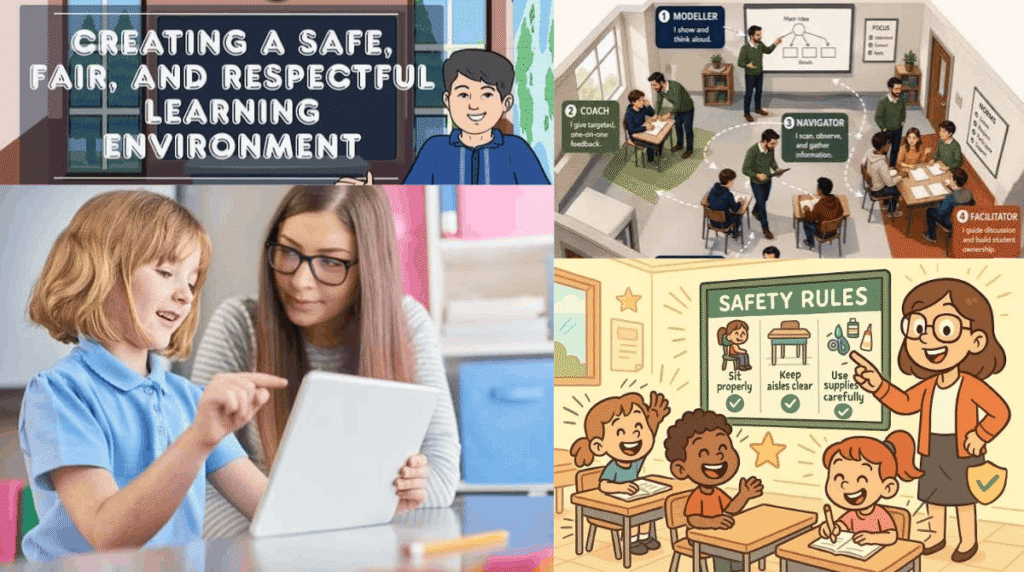
I bring this up because it explains the whole topic better than any policy document. Games are great. Tech is great. But a classroom has rules underneath it, and when we ignore them, a fun lesson can quietly hurt someone. Safety, fairness, and fun need each other. Lose one and the other two start wobbling.
Safety means more than a fire drill
Ask someone what classroom safety is and you’ll hear about evacuation routes and lockdown plans. Those matter. But two other kinds of safety shape what happens in a normal Tuesday, and they get far less attention.
The emotional kind. A student who thinks they’ll be laughed at stops raising their hand. It really is that simple. One snarky comment that goes unchallenged teaches the whole room that wrong answers cost something, and after a few weeks the quiet kids are even quieter. Students have a right to walk in without bracing for embarrassment. Teachers have a right to work in a building where leadership backs them up when they enforce that, rather than leaving them to sort out every incident alone.
The digital kind. Here is where I think most of us are a bit careless. Every app you introduce collects something: usernames, scores, email addresses, sometimes more. In the US, laws like FERPA and COPPA exist because student information is sensitive, and plenty of other countries have their own versions. Many teachers figure that a popular tool must have been checked by someone in the district office. Maybe. Maybe not. You could easily be the first person who ever read the terms.
You don’t need legal training to do this well. A few small habits go a long way:
- See if your school keeps an approved list of tools before you sign up a whole class for something new.
- Where the platform allows it, use nicknames or first names.
- Skim the privacy page once, looking for whether student data is shared with advertisers or kept after an account is closed.
- Tell families what you’re using. Two sentences in a week-one email can prevent a long, awkward thread in week six.
One more safety right deserves a mention, and it belongs to you. Answering parent emails at ten at night and grading until midnight gets praised as dedication. In reality it’s how good teachers burn out and leave. Choosing your hours is reasonable. “I reply to messages between 7 and 5” is a perfectly professional sentence, and your school should respect it.
Fair is not the same as identical
For years I think a lot of us equated fairness with sameness. Same worksheet, same timer, same deadline for everybody. It looks tidy. It also ignores that your students aren’t standing on the same starting line.
Take access first. One student has fast wifi and a laptop of their own. Another shares a single phone with two brothers. If your lesson leans on a tool, your plan has to cover the second kid too. You can run the activity during class, keep a paper version handy, or simply decide that the online piece never counts as homework. Easy to say, and surprisingly easy to forget when you’re rushing.
Then think about accessibility. Some students use screen readers. Some have dyslexia or need extra processing time. Some can’t catch audio clearly. Most modern platforms have text-to-speech, adjustable timers, captions, and high-contrast modes, and switching them on takes about thirty seconds. Students with documented accommodations are legally entitled to them, and that covers the digital side of your classroom, not just the printed test.
Grading is the third piece. You have every right to grade by clear and consistent standards. Students have a right to see those standards before they start the work. A rubric handed out in advance protects the student from surprises and protects you when someone says you play favorites. It might be the cheapest fairness tool in teaching.
Last, game design, which brings us back to the kid in the corner. Speed-based scoring thrills some students and wrecks others. If a game ranks people in public, ask whether that ranking helps anyone learn anything. Lots of teachers quietly switch to team scoring, show only the top few spots, or choose modes where everybody moves at their own pace. The target is simple: every student leaves knowing a bit more than when they came in. Nobody should leave knowing mostly that they were slowest.
Teachers have rights too
Conversations about rights in schools tend to focus on students, and that makes sense. Still, the adult in the room holds real professional rights, and knowing them makes you steadier when someone leans on you.
You’re entitled to reasonable academic freedom. Even when the curriculum is set, you usually get a say in how a concept is taught, which examples you use, and what order works for your group. You’re entitled to professional development that connects to what you actually teach, not one required slideshow a year on something unrelated. You’re entitled to fair evaluation, which means seeing the criteria and getting a chance to respond. And in most places, you can join a union or professional association, which often decides whether a concern gets heard or gets filed away.
None of this puts you at war with your school. It means that when a request seems off, you can calmly say, “Here’s what the handbook says,” instead of swallowing it and stewing until November. Colleagues and administrators tend to respect a teacher who knows the rules and brings them up politely.
So where does the fun come in?
Fun is the part your students would vote to keep, and honestly, they’d have a point. People pay closer attention when they’re enjoying themselves. They remember more and try harder. A solid game turns retrieval practice into something that feels like play. It can coax a shy student into typing an answer because getting it wrong costs nothing. It can transform a dreaded vocab review into the best fifteen minutes of the week.
That’s the reason platforms like Blooket, Kahoot, Quizizz, and Gimkit took off. A teacher writes or borrows a question set, students join with a code, and the energy in the room changes almost instantly. Used well, they work for review, quick checks, and low-pressure practice. Used carelessly, they’re just a way to burn the last twenty minutes of a Friday.
Before you launch one, ask yourself a plain question: what will students be able to do afterward that they couldn’t do before? If you have an answer, like recalling key terms, practicing a skill, or surfacing a common mistake, then the game has a job to do. If the honest answer is “they’ll have fun,” that’s okay now and then. It just shouldn’t be the entire plan.
A few things worth trying:
- Play after teaching, not instead of it. Games are better at pulling knowledge out of memory than putting it in.
- Change the mode now and then. Alternate between competitive rounds and cooperative or self-paced ones so different kids get their moment.
- Check the results. Most platforms show which questions were missed most. That’s free information about what to reteach tomorrow.
- Let students write the questions. Coming up with a believable wrong answer takes more thinking than picking the right one.
- Keep it short. Ten or fifteen focused minutes usually beats a whole period.
How the three fit together
I don’t think strong teachers pick between safe, fair, and fun. They treat them as one thing with three sides.
A safe room is where a student can risk a wrong answer. A fair room gives every student a real shot at answering. A fun room makes them want to. Pull out any one and the rest sag. A fun game that isn’t fair breeds resentment. A fair class with no joy in it wears everybody down. And a fun, fair class that handles student data carelessly puts kids at risk in a way nobody notices.
If you want a starting point, try a small audit this week. Choose one tool you use constantly and run it through four questions. Is student data protected? Can every student actually reach it? Does it reward learning, or only speed? Would a student having the worst day of their year still feel included? Maybe nothing needs fixing. More likely you’ll find one small thing, like a hidden leaderboard, a paper backup, or a note home to parents, and the whole activity will run better.
Teaching has never been easy, and the tools keep piling up. But the core idea hasn’t changed. Students deserve a place where they’re protected, treated honestly, and given a reason to care. Teachers deserve exactly the same. When both are true, technology goes back to being what it should have been all along: a useful extra, not the main event.
Disclaimer:
This article is for general educational purposes only and is not legal advice. Laws and school policies on student privacy, accessibility, and teacher rights vary by country, state, and district, so please check your local regulations and your school’s guidelines before making decisions. Platforms mentioned, including Blooket, Kahoot, Quizizz, and Gimkit, are trademarks of their respective owners. [Blooket.blog is not affiliated with or endorsed by these platforms. Edit this line to match your site’s actual status.]

Pingback: Blooket Trading in 2027: How to Swap Blooks Without Getting burn