

Open enough packs in Blooket and you start noticing patterns. Commons show up constantly. Uncommons feel routine. Then somewhere around your fortieth or fiftieth opening, you start wondering why that one Legendary you keep hearing about hasn’t shown up once. That’s the moment most players go looking for a rarity calculator — something that turns the vague sense of “this feels rare” into an actual number.
This guide covers the full rarity system in Blooket, how the odds actually break down tier by tier, and how a Blook odds calculator uses that information to tell you what your tokens are really buying.
The Rarity Ladder, From Bottom to Top
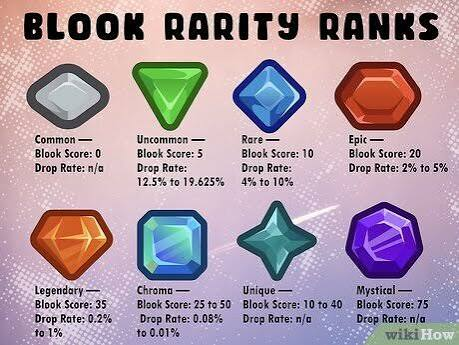
Blooket sorts its Blooks into a tiered system, and where a Blook sits determines both how often it drops and how much it’s worth. The full ladder, from most common to rarest, runs:
Common → Uncommon → Rare → Epic → Legendary → Chroma → Unique → Mystical
A couple of tiers exist slightly outside the normal pack system — Uniques and Mysticals are usually tied to specific events rather than regular purchases — but the six tiers from Common through Chroma are what you’ll actually be pulling from packs, and they’re what most calculators are built around.
Here’s roughly how the odds shake out at each level, based on drop rates across the current pack catalog:
- Common — the backbone of every pack. Depending on which pack you’re opening, commons can make up anywhere from half to the vast majority of pulls.
- Uncommon — still frequent, usually showing up in a solid chunk of openings. This is the tier where most packs settle after commons.
- Rare — noticeably less frequent, generally landing somewhere in the mid-single-digit to low-double-digit percentage range depending on the pack.
- Epic — this is where things start to feel like a real pull. Epic rates typically sit in the low single digits, and in packs with several Epics available, the odds for any one specific Epic split even further.
- Legendary — the headline chase tier for most players. Legendary rates usually fall somewhere between roughly a fifth of a percent and one percent, depending on the pack and the specific Blook.
- Chroma — the rarest tier most players will ever realistically pull. Chroma rates typically sit in the range of a few hundredths of a percent, meaning some can take thousands of pack openings to show up with any real confidence.
One detail that trips a lot of people up: tier name and actual rarity don’t always line up perfectly. A Legendary in one pack might have a noticeably higher drop rate than a Legendary in a completely different pack, since each pack sets its own tier weighting independently. There are even cases where a specific Legendary Blook sits at a rate low enough to rival a Chroma from another pack. The label tells you the category — it doesn’t guarantee the exact odds.
How a Rarity Calculator Actually Reads These Numbers
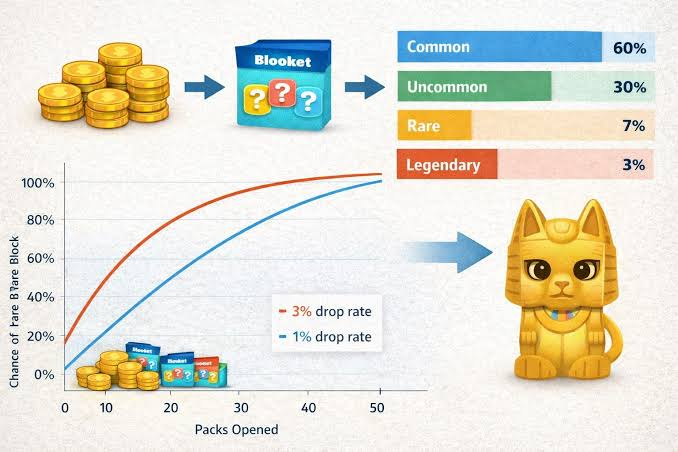
A Blook odds calculator takes the raw drop rate for whatever you’re chasing and runs it through a probability formula to tell you your realistic chances across multiple pack openings, rather than just showing you the flat, single-pull percentage.
The formula behind almost every version of this tool is the same:
Cumulative Probability = 1 − (1 − p)ⁿ
p stands for the drop rate of your target Blook, written as a decimal. n is the number of packs you’re planning to open. This formula matters because a single-pull percentage on its own is kind of useless for planning — nobody opens exactly one pack and stops. What you actually want to know is your odds after opening, say, 100 or 300 packs, and that requires compounding the probability correctly rather than just multiplying the flat rate by the number of attempts.
For context on how steep this curve gets: a Legendary sitting around a 0.5% drop rate needs roughly 138 pack openings just to cross a 50/50 shot at landing it. Push that down to a Chroma sitting around 0.03%, and you’re looking at over 2,000 openings before you hit that same 50% mark. The gap between “rare” and “extremely rare” isn’t linear — it’s closer to exponential, which is exactly why doing this math by hand gets tedious fast and why a calculator earns its keep.
It’s also worth remembering that every pack opening is a completely independent event. Whatever happened on your last fifty pulls has zero influence on your fifty-first. There’s no hidden counter building toward a guaranteed drop. A calculator reflects this honestly — it’ll never tell you that you’re “due” for anything, because that’s not how the underlying math works. What it will tell you is your actual cumulative chance given a specific number of attempts, which is a very different (and much more useful) piece of information.
What You Can Actually Do With One
Once you understand what the calculator is doing, using it becomes pretty intuitive. Most rarity calculators let you approach the problem from two directions.
Starting from a pack. Pick the pack you’re eyeing, and the calculator will lay out every rarity tier inside it along with each Blook’s individual drop rate. This is useful when you’re deciding which pack is even worth your tokens in the first place, since some packs are noticeably more generous at the top end than others.
Starting from a specific Blook. If you already know exactly what you want — a particular Legendary or Chroma — you can enter that target directly and work backward to figure out how many packs, and therefore how many tokens, you’d realistically need to reach a given confidence level, whether that’s 50%, 75%, or 90%.
Some of the more detailed tools also factor in resale. Since duplicate Blooks can be sold back for tokens, a calculator that accounts for that recycling effect gives you a more accurate read on your real net cost, rather than treating every token spent as gone for good.
Reading the Results Without Getting Discouraged
It’s easy to see a low percentage and assume the tool is telling you something’s broken or unfair. It isn’t — that’s just what genuine rarity looks like when it’s expressed honestly instead of dressed up. A Chroma sitting at a fraction of a percent is supposed to be hard to get. That’s the entire design.
What a calculator gives you isn’t a shortcut around the rarity — it’s clarity about what you’re actually signing up for. Knowing in advance that a specific Chroma might realistically take a few thousand pack openings changes how you approach it. Maybe you decide it’s worth patiently saving toward. Maybe you decide a different, slightly more common target makes more sense for now. Either way, that’s a much better position to make the call from than just opening packs on hope alone.
Final Thoughts
The rarity system in Blooket isn’t random noise — it’s a structured, tiered set of odds that gets steeper the closer you get to the top. A Blook odds and rarity calculator doesn’t change any of that math; it just makes it visible. Understanding roughly where each tier sits, and how compounding probability actually works across dozens or hundreds of openings, turns pack-opening from a guessing game into something you can genuinely plan around — which, for a lot of players, ends up being half the fun.
Disclaimer
Drop rates and rarity figures referenced in this article are community-sourced estimates and may vary by pack, by season, or as Blooket updates its systems over time. This guide and any calculators referenced are independent, fan-made resources, not affiliated with or endorsed by Blooket.

