
Picture this. It’s Friday afternoon, twenty-six students are restless, and you have exactly one shot at getting them to review anything. You open Blooket, stare at the game mode list, and hesitate.
Gold Quest or Tower Defense?
I’ve seen both modes save a lesson, and I’ve seen both flop. The difference was never the mode itself. It was whether the mode matched the room. So let’s figure out which one fits your situation in 2026.
Gold Quest in a Nutshell
Gold Quest is Blooket at its most chaotic. You answer a question, and a right answer earns you a chest. There are three to choose from, and you never know what’s inside. Maybe a big pile of gold. Maybe a chance to steal from another player. Maybe a nasty surprise that shrinks your stash.
So the game has two layers. Knowledge gets you to the chest, but luck decides what happens once you’re there. That’s why a kid who’s only okay at the material can win the whole thing, and why the top student can lose everything in the final ten seconds.
Some people love that. Others rage-quit. Very few feel nothing.
Tower Defense in a Nutshell
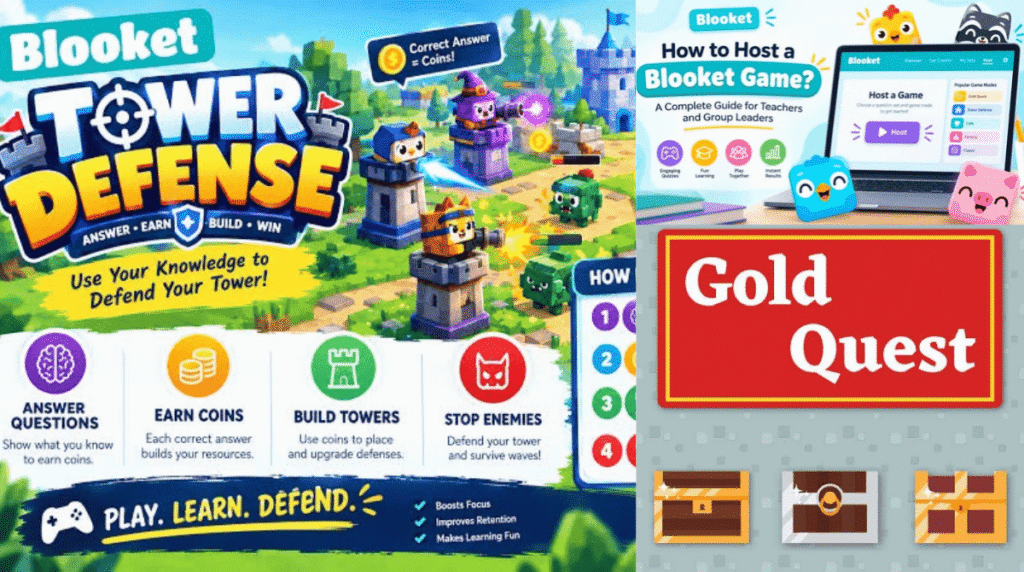
Tower Defense is a completely different animal. There’s no stealing and no rivalry. Everyone is on the same side, answering questions to earn coins and spending them on towers and upgrades to hold off waves of enemies.
Now your answers actually build something. A correct answer means a stronger defense. A wrong one leaves a gap. You end up making small decisions constantly: upgrade the tower you already have, or save up for a better one? Spend now, or wait for the next wave?
The mood in the room changes too. Instead of glancing at a leaderboard, students lean toward each other and say things like “wait, don’t spend it yet.”
Head-to-Head Comparison
Gold QuestTower DefenseStyleCompetitiveCooperativeEnergyLoud and chaoticFocused and strategicLuck factorHighLow to moderateTies to the questionsLooseStrongTime to learnAbout one minuteA few minutesBest forFun, rewards, quick sessionsReview, teamwork, longer periods
Where Gold Quest Wins
Speed and simplicity. You can explain Gold Quest in the time it takes students to sit down. Answer, pick a chest, see what happens. Nobody needs a tutorial, so you lose no class time.
Energy. Nothing gets a room buzzing like someone yelling “he stole my gold!” across the classroom. If your students are sluggish, this mode wakes them up fast.
Repetition. Because rounds move quickly, students see many questions in a short window. If you want volume, meaning lots of practice reps, the pace works for you.
Fairness to the underdog. Strugglers stay in the game because luck can lift anyone. That keeps motivation up for students who’d otherwise give up when they fall behind.
Where Gold Quest Falls Short
Here’s the catch. The question is basically a ticket to the fun part, and some students figure that out quickly. They rush, guess, and hurry to the chests. Content becomes an afterthought.
The randomness can also backfire. Losing a big stash to a random swap feels terrible, and a few students will take it personally. If your class has a couple of sensitive competitors, expect some drama.
Where Tower Defense Wins
Real reasons to care about answers. Every correct answer helps the whole team, and every miss costs something visible. That gives students a stronger reason to slow down and think.
Teamwork. Quiet students often step up here. They aren’t performing for the class, they’re helping the group survive. I’ve watched shy kids give strategy advice in Tower Defense that they’d never volunteer in a normal discussion.
Less bad feeling. There’s no stealing and no getting robbed, so there’s nothing to sulk about. Losses are shared, which softens them.
Better for review days. If a test is coming, this is the mode I’d reach for. Tying questions directly to progress makes the material feel like it matters.
Where Tower Defense Falls Short
It takes longer to get going. New players need a moment to understand towers, upgrades and waves, and your first round will probably include some confused looks. Run a short practice game before you use it for anything important.
There’s also the “one bossy player” problem. In any team setup, one confident student can end up calling every shot while others just answer questions. And if the team loses, some kids will quietly (or not so quietly) blame each other.
Which Mode Fits Which Situation?
Let me make this practical.
Pick Gold Quest if:
- You have 10 to 15 minutes to fill
- The class needs to blow off steam
- It’s a reward day or the last period of the week
- Your group enjoys friendly rivalry
- You’re playing with friends and want instant drama
Pick Tower Defense if:
- You’re reviewing for a quiz or test
- You want students collaborating
- You have a longer block to work with
- Your class gets upset by random losses
- You want the questions to feel important
What About Learning?
This is the question that really matters for teachers, so I’ll be direct. Engagement and learning aren’t the same thing.
Gold Quest is very engaging, but the learning is shallow if you rely on it alone. Students remember the thrill of a big steal far more than the fact they answered. Tower Defense gets the edge on learning because the questions are woven into the strategy, so students have to care about getting them right.
That doesn’t make Gold Quest useless. Fast repetition builds fluency, especially for vocabulary, math facts and quick recall. It just works better as practice than as deep review.
My Verdict for 2026
If you want a single winner for classroom use, Tower Defense takes it. The questions matter more, the mood is more positive, and students walk away having practiced both content and communication.
If you want a single winner for fun, Gold Quest takes it, easily. It’s the mode people ask to replay.
The best move, honestly, is to use both. Start a week with Tower Defense for focus, then finish it with Gold Quest as a reward. Students get variety, you get better learning, and neither game gets stale.
Frequently Asked Questions
Is Gold Quest good for learning? It’s good for fast practice and motivation, but it relies partly on luck. Pair it with a more focused mode for deeper review.
Is Tower Defense better for teams? Yes. It’s built around cooperation, so it’s the better choice when you want students working together.
Which mode is easier to run? Gold Quest. The rules are simple enough to explain in under a minute.
Which mode is better for a large class? Both work well, but Gold Quest scales easily since everyone plays independently. Tower Defense works best when students are engaged and can communicate.
Can I use both in one lesson? Absolutely. Try Tower Defense first for review, then Gold Quest as a short reward round.
Final Thoughts
Gold Quest and Tower Defense are two of Blooket’s most popular modes because they give you two totally different experiences: rivalry and luck on one side, teamwork and strategy on the other. Neither is universally better. The right pick depends on your goal, your class, and how much time you have.
So try both, watch how your students react, and trust what you see. Which one does your class ask for the most? Tell me in the comments.
DISCLAIMER
Gold Quest or Tower Defense? Compare gameplay, learning value, and best use cases to pick the right Blooket mode for your class in 2026.it isonly information


Pingback: blooket.blog Blooket Game Codes vs. Cheat Codes: What's the Difference?