Say “Blooket” to a room full of eleven-year-olds and watch what happens. Nobody shrugs. Somebody’s already arguing about which Blook is the best pull, somebody else is mad they got their gold stolen last round, and at least one kid is trying to explain the difference between a Chroma and a Mystical to a teacher who has no idea what either word means. That’s not the reaction you’d expect from a study tool. But Blooket never really stayed a study tool for long.
Nothing New Under the Sun, At First
When Blooket showed up, it wasn’t stepping into an empty room. Kahoot had already spent years proving that a countdown clock and a leaderboard could get a class fired up over vocabulary words. Other tools copied the formula pretty closely: answer, watch your name move on a screen, repeat.
The catch was that after the first round, you’d basically seen the whole game. Different questions, sure. Same everything else.
Whoever sat down and planned out Blooket seems to have noticed that gap. Their answer was to stop treating the trivia questions as the game itself and start treating them as the cover charge to get into something bigger.
Two Brothers and a Different Kind of Reward
Credit for Blooket goes to brothers Ben and Tom Stewart. From what’s publicly known about the platform, the goal wasn’t to build a better quiz — it was to build something that felt like an actual game, one a kid might pick up on their own, homework or not.
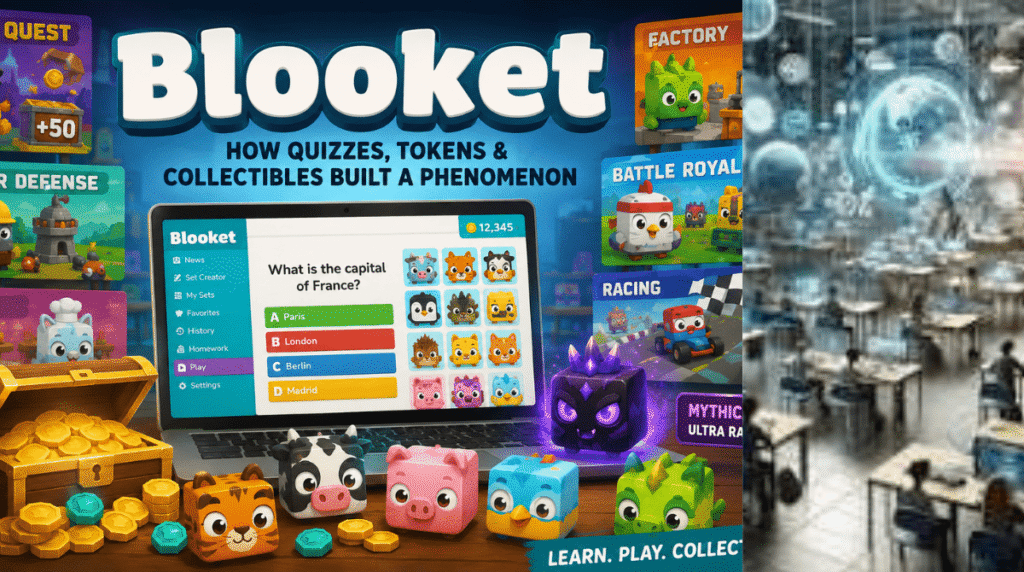
So they bolted a whole second system onto the quiz mechanic. Answer a question right, earn tokens. Spend tokens on a box, and maybe you walk away with a Blook — a little character that can be as plain as a common critter or as rare as a Chroma nobody in your class has seen yet. A lot of players barely register this part. Plenty of others get completely obsessed, trading tips about drop rates and hunting for that one rare Blook like it’s a piece of currency in its own right.
It sounds like a small design choice. It ended up being the whole engine.
Right Idea, Right Moment
None of that clever design would’ve traveled nearly as far without a specific stretch of bad timing for the rest of the world. Blooket’s growth curve lines up almost exactly with 2020, when schools everywhere got shoved into remote and hybrid learning overnight. Teachers who’d never run a class through a laptop camera were suddenly trying to hold thirty kids’ attention through a screen, and most of the old classroom tricks just didn’t work anymore.
Blooket happened to check a lot of boxes at once. No app. Works in whatever browser a school-issued Chromebook happened to have open. Simple enough to set up between class periods without calling IT. From there it spread the ordinary way — a teacher posts about it in a Facebook group, a kid clips a chaotic Gold Quest round for TikTok, and a few months later it’s the thing every staff room is talking about. The pandemic didn’t invent Blooket. It just handed it an audience faster than it probably would’ve found one otherwise.
Why People Kept Coming Back
Getting noticed is the easy part, comparatively. Staying interesting is harder, and this is where Blooket’s habit of never settling on one format actually paid off. Rather than riding a single winning mode, they kept adding new ones, all built on top of whatever questions a teacher had already typed up months earlier.
Classic mode is the closest thing to a standard quiz game — the baseline. Gold Quest changes the whole mood by letting players steal tokens off each other, which turns a review session into something closer to a low-stakes heist. Tower Defense makes you spend what you’ve earned fighting off waves of enemies. Café hands you a tiny restaurant to run. Factory turns correct answers into a production line. Battle Royale strips everything down to a last-one-standing scramble. Then there’s racing, fishing, pirates — the roster kept growing, and every new mode gave a teacher a reason to bring the same worn-out material back one more time without the class groaning about it.
Small detail on the surface. But it’s the difference between a tool kids put up with and one they actually ask for.
When the Collecting Took Over
At some point the Blooks stopped being a side feature and became the reason a good chunk of players were even there. Kids started comparing pack odds like stock prices. Fan wikis sprang up cataloging every rarity tier. YouTubers built whole channels around opening Blooket boxes on camera and reacting to what dropped, more or less the same way people film themselves opening card packs.
Blooket leaned into it instead of fighting it. Seasonal events brought limited-run Blooks tied to holidays. Eventually an ultra-rare “Mystical” tier arrived, available only through special tournaments. A paid Blooket Plus tier followed, adding extra modes and cosmetics for players who wanted more of it. None of that was necessary to run a review game. It’s exactly what turned Blooket from a tool students used into something they actually cared about.
Past the Classroom Door
At this point Blooket sits comfortably alongside names like Kahoot and Gimkit as one of the standard tools for gamified learning, but it’s built a different kind of identity than either of them. The collecting system and the constant stream of new modes give it more of a rhythm you’d expect from a live game getting regular updates, not a static piece of edtech software. There are whole communities dedicated to nothing but tracking Blook rarities. There are teenagers now who first met Blooket as nine-year-olds reviewing multiplication tables — and they still know every game mode by name.
That’s really the shape of the whole story. Blooket didn’t turn into a phenomenon because it was especially educational. It turned into one because it was genuinely fun, with the learning riding shotgun instead of driving. The pandemic gave it a push it might not have gotten otherwise. But the collecting, the ever-expanding list of game modes, and the decision to treat trivia as a means to an end rather than the whole point — that’s what kept people around long after remote learning ended and everyone went back to sitting in actual classrooms.